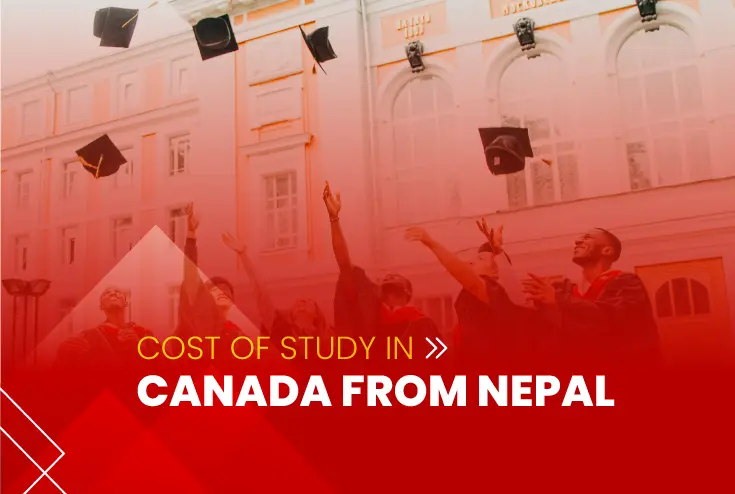
"How much money do I actually need to study in Canada?" This is the real question behind almost every search about studying in Canada from Nepal, and it does not have one universal answer. The total cost depends on your study level, the program and institution you choose, the province or city you will live in, your accommodation and lifestyle choices, travel, immigration and application expenses, and whether you receive any scholarship or family financial support.
What this guide can do is give you an honest, sourced framework for calculating your own number, rather than a single figure that may not apply to your situation. It also draws a distinction that most articles on this topic skip over: the actual cost of studying in Canada, the minimum amount you must prove to the Government of Canada for a study permit, and the amount you should realistically budget, are three different numbers.
Table of Contents
- Introduction
- How Much Does It Cost to Study in Canada from Nepal?
- Total Cost to Study in Canada from Nepal
- Tuition Fees in Canada for Nepali Students
- Living Expenses in Canada for Nepali Students
- Canada Study Permit Financial Requirements
- Study in Canada from Nepal: Requirements Checklist
- How Much Does a Canada Study Permit Cost from Nepal?
- Canada Study Cost by Province and City
- Can I Study in Canada Without IELTS?
- Can I Get a 100% Scholarship in Canada?
- Can I Get PR After a 2-Year Study Program in Canada?
- What Is the Visa Success Rate for Canada from Nepal?
- How Much Money Should a Student from Nepal Prepare Before Going to Canada?
- Can International Students Work While Studying in Canada?
- How to Reduce the Cost of Studying in Canada
- Is Canada Affordable for Nepali Students?
- Why Choose Maple Education for Canada Study Guidance?
- Frequently Asked Questions
How Much Does It Cost to Study in Canada from Nepal?
There is no single "cost to study in Canada" figure that applies to every applicant, because the total is built from several separate components, each of which varies by individual circumstances:
- Tuition fees, which differ by institution, program, and study level
- Living expenses, including accommodation, food, transportation, and personal costs
- Study permit and application fees charged by the Government of Canada
- Biometrics fees
- A medical examination, if required for your situation
- Language testing fees, if your program requires one
- Educational document preparation and translation costs
- Airfare to and from Canada
- An accommodation deposit or first month's rent, often required before or on arrival
- Health insurance, where not automatically included through your institution or province
- Books and study materials
- Initial settlement expenses, such as a local phone plan, transit pass, and basic household items
The total differs between students mainly because of three factors: the institution and program (a public university master's program and a private college certificate can have very different tuition), the city (Toronto and Vancouver cost noticeably more to live in than many smaller cities), and the individual's existing resources (a fully self-funded student has different planning needs than one relying on an education loan or family support).
A useful way to think about your first year is as a framework, not a fixed number:
First-year cost = tuition + living expenses + travel + study permit/application costs + insurance, medical exam and testing costs + initial settlement costs
This guide walks through each component with current, sourced figures where they exist, so you can build your own realistic total instead of relying on a generic estimate.
Total Cost to Study in Canada from Nepal
To calculate your own total, work through the framework above component by component rather than searching for a single "total cost" figure online. A practical way to do this:
- Start with tuition for the specific program and institution you are applying to (not a national average, though the averages below are a useful starting reference point).
- Add a full year of realistic living expenses for the specific city where you'll study, not just the IRCC minimum (explained in the next sections).
- Add one-time costs: airfare, accommodation deposit, study permit and biometrics fees, medical exam if required, and any language test fee.
- Add a reasonable buffer for the unexpected, since a new city and a new banking, phone, and healthcare system almost always involve setup costs you can't fully predict.
An important point most guides don't make clearly enough: your first year will usually cost more than your second year. Many of the largest expenses, airfare, an accommodation deposit, a medical exam, biometrics, furnishing a room, and setting up a phone or bank account, are one-time costs that will not repeat in year two. From your second year onward, your budget is closer to tuition plus ongoing living expenses alone, assuming your tuition doesn't increase and your living situation is already established. Some institutions do increase tuition annually for continuing students, so check your specific institution's policy on this rather than assuming your first-year tuition figure will stay fixed for the whole program.
Tuition Fees in Canada for Nepali Students
Tuition in Canada varies significantly by study level, institution, program, and province. There is no single "Canada tuition fee," and any article claiming otherwise is oversimplifying.
As a national reference point, Statistics Canada's most recent figures (cited on the Government of Canada's official international education portal, 2026 data) show average international tuition of approximately CAD 41,746 per year for undergraduate students and approximately CAD 24,028 per year for graduate students. These are national averages across all institutions and programs, so treat them as a starting orientation point, not a prediction of what any specific programme will charge you.
Bachelor's degree: International undergraduate tuition typically runs from roughly CAD 15,000 to over CAD 45,000 per year depending on the institution, program, and province, with professional and specialized programs (such as engineering or business) often at the higher end.
Master's degree: Master's tuition varies widely by program type. Research-based master's programs at public universities are often lower than professional master's programs (such as an MBA), which can be significantly higher due to their career-focused positioning.
College diploma: Public college diploma programs are generally, though not always, lower in tuition than university bachelor's degrees, but this varies by college, program, and province.
Postgraduate diploma: Postgraduate diploma tuition also varies considerably; some postgraduate diplomas are priced similarly to college diplomas, while others, particularly in business or technology fields at larger institutions, are priced closer to a professional master's.
A few points that matter for realistic planning:
- International students almost always pay a different (higher) tuition rate than domestic Canadian students. This is standard across nearly all Canadian institutions.
- Province affects overall cost, both through direct tuition-setting differences between provinces and through the cost of living in that province.
- Some professional programs cost significantly more than a general arts, science, or business program at the same institution, regardless of study level.
- Always confirm tuition directly on the specific institution's official website for your intended program, since published national averages can differ substantially from what a specific school charges.
Living Expenses in Canada for Nepali Students
Living expenses are usually the second-largest cost after tuition, and this is where the gap between "the government minimum" and "what you will actually spend" tends to be widest.
The major categories of living expense are:
- Accommodation (on-campus residence, off-campus rental, or homestay)
- Food and groceries
- Local transportation
- Phone and internet
- Personal and incidental expenses
- Utilities, if not included in rent
- Health insurance, where not automatically provided
- Study materials and supplies
Major cities versus smaller cities: Living costs in Toronto, Vancouver, and other large metropolitan areas are generally higher than in smaller cities and towns, primarily driven by accommodation costs. A student choosing a smaller city or a college town can often meaningfully reduce their living budget compared to a downtown apartment in a major city, though this needs to be weighed against other factors like program availability, part-time job opportunities, and personal preference.
Do not assume the lowest advertised monthly figure applies to you. Some institutional or third-party websites advertise an optimistic "students can live on $X per month" figure that assumes shared accommodation, minimal discretionary spending, and a specific city. Your actual costs depend on your housing choice, city, lifestyle, and whether you have roommates or dependents.
The IRCC minimum is not a lifestyle estimate. As explained in the next section, the federal government's cost-of-living figure for study permit purposes is a floor set for immigration processing, not a prediction of what it costs to live comfortably in any specific Canadian city. Students who plan their entire budget around only the IRCC minimum, especially in a higher-cost city, often find their real monthly costs are higher.
Canada Study Permit Financial Requirements
This is one of the most important sections to understand correctly, because it is very commonly confused with "total cost of studying."
According to IRCC's official guidance, applicants must prove they have enough money, without needing to work in Canada, to cover:
- Tuition fees for their program of study
- Living expenses for themselves and any family members accompanying them
- Transportation to and from Canada for themselves and any accompanying family members
For applications made on or after September 1, 2026, the minimum cost-of-living amount for a single applicant studying outside Quebec is CAD 23,448 per year. This figure covers living expenses only; it does not include tuition or transportation, which must be demonstrated separately, on top of this amount. If family members are accompanying the applicant, the required amount increases according to family size (for example, CAD 29,192 for two people, rising to CAD 62,054 for seven, with CAD 6,318 for each additional person beyond that, per IRCC's published table as of the September 2026 update).
For programs longer than one year, IRCC requires applicants to explain how they intend to finance the full duration of their studies, not just the first year. This does not mean showing the entire multi-year cost as available funds upfront in every case, but it does mean your application should include a credible explanation, such as an ongoing scholarship, a documented family income source, or an education loan structured to cover future years.
Quebec has its own, separately administered financial requirement, assessed through the Ministère de l'Immigration, de la Francisation et de l'Intégration (MIFI) as part of the Certificat d'acceptation du Québec (CAQ) process. This is not the same figure or process as the federal IRCC table above. If you are applying to a Quebec institution, confirm the current financial requirement directly through Quebec's own immigration authority rather than assuming the federal figure applies.
Acceptable evidence of funds generally includes documents such as:
- Bank statements (commonly for the past four months)
- Proof of a Canadian bank account, if funds have already been transferred
- An education loan approval letter from a bank
- A Guaranteed Investment Certificate (GIC) from a participating Canadian financial institution
- A scholarship or funding letter, if applicable
- A letter from a parent or sponsor confirming financial support, ideally accompanied by evidence of that sponsor's own income or savings
This is an area where the integrity of your documentation matters enormously. IRCC officers assess not just how much money you have, but where it came from and whether it will realistically remain available throughout your studies. Building a financial history through unusual last-minute deposits, or presenting funds that are not genuinely yours or genuinely available, is a well-documented cause of refusals and should be avoided entirely. If you are unsure how to document your specific financial situation, this is exactly the kind of question worth raising with a qualified counsellor before you apply.
Study in Canada from Nepal: Requirements Checklist
It helps to separate two categories of requirement that are often blended together in generic guides: university/college admission requirements and study permit requirements. You need to satisfy both, but they are assessed by different bodies at different stages.
Typical admission requirements (assessed by the institution):
- Completed application form
- Academic transcripts and certificates
- Language proficiency test results, if required by the specific program (see the IELTS section below)
- Statement of purpose or personal statement, where requested
- Letters of recommendation, where requested
- Application fee paid to the institution
Typical study permit requirements (assessed by IRCC):
- A valid Letter of Acceptance from a Designated Learning Institution (DLI)
- A Provincial or Territorial Attestation Letter (PAL/TAL), where required (most new applicants from outside Canada need one, though master's and doctoral students at public DLIs have been exempt from this requirement since January 1, 2026)
- A Certificat d'acceptation du Québec (CAQ), if studying in Quebec
- A valid passport
- Proof of financial support, as outlined above
- Academic documents supporting your application
- A letter of explanation, if useful to clarify your study plan or circumstances
- A medical examination, if required for your situation
- Biometrics, where applicable
- Any other document requested by IRCC for your specific application
Do not assume a language test is universally mandatory. Whether you need IELTS or another test depends on the specific institution and program's own admission policy, not on a single immigration-wide rule; this is covered in more detail below.
How Much Does a Canada Study Permit Cost from Nepal?
It's worth stating this clearly and separately, because government fees are often bundled together with tuition and living costs in a way that makes the numbers confusing.
Government fees for the study permit application itself:
- Study permit application fee: CAD 150
- Biometrics fee: CAD 85 per person (with a family cap of CAD 170 where applicable)
Other application-related costs, which are separate from the government fees above:
- Immigration medical examination, where required: typically in the range of roughly CAD 200 to 400, paid directly to an IRCC-approved panel physician, not to IRCC itself (this fee is set by the examining physician or clinic, not by the government)
- Language testing fees (such as IELTS or an equivalent accepted test), if required by your specific institution or program
- Document preparation, notarization, or translation costs, which vary depending on what your specific documents require
- Travel costs to and from a visa application centre, if biometrics or document submission require an in-person visit
The key distinction to keep in mind: the CAD 150 study permit fee and CAD 85 biometrics fee are what you pay the Government of Canada to process your application. They are not related to, and far smaller than, your tuition and living-expense proof-of-funds requirement. A student who has budgeted only the visa/permit fees has budgeted for a small fraction of what they actually need to demonstrate and eventually spend.
Canada Study Cost by Province and City
Where you study in Canada has a real effect on your total cost, mainly through living expenses and, to a lesser degree, tuition-setting differences between provinces.
- Ontario is home to many of Canada's largest institutions and cities, including Toronto, and living costs in its major metropolitan areas tend to be on the higher end nationally.
- British Columbia, particularly Vancouver, is also among the higher-cost provinces for accommodation, though other BC cities can be more moderate.
- Alberta has cities such as Calgary and Edmonton that are often more moderately priced than Toronto or Vancouver for accommodation, while still offering large institutions and job markets.
- Manitoba and Saskatchewan generally offer lower living costs than Ontario or BC's major cities, which some students weigh against differences in city size and post-study job market considerations.
- Nova Scotia and New Brunswick, along with other Atlantic provinces, often have lower accommodation costs than Canada's largest cities, alongside smaller local job markets.
The point is not that any province is inherently "better" than another. It is that the same tuition and the same government proof-of-funds requirement can sit on top of very different real living costs, depending on where you choose to study. A student comparing two similar programs at two different institutions should factor in the city's typical accommodation costs, not just the sticker-price tuition, when judging total affordability. Always check current, city-specific cost-of-living data (many institutions publish their own estimated living-cost figures for prospective international students) rather than relying on a single national average.
Can I Study in Canada Without IELTS?
IELTS is one of several English-language tests accepted by Canadian institutions, but it is not universally required by every institution or program, and it is not, by itself, an immigration requirement set by IRCC in the way a study permit fee is.
A few things to understand:
- Language testing requirements are typically set by the institution and program, not by IRCC directly. Some programs require IELTS specifically; others accept alternative tests such as PTE Academic, TOEFL, Duolingo English Test, or CAEL, depending on the institution's own policy.
- Some applicants may qualify for a waiver or exemption from a language test requirement, depending on their prior education (for example, having completed previous education in English) and the specific institution's rules. This varies by institution and is not a blanket immigration exemption.
- Immigration requirements and admission requirements are not identical. Even if a student's chosen program does not require IELTS for admission, IRCC may still ask for evidence of language ability as part of a study permit application in certain circumstances, and requirements can differ by visa office and individual case.
Because this varies by institution, program, and individual circumstances, this guide cannot tell you definitively that you personally can obtain a Canadian study permit without any English-language test. What it can tell you is that IELTS is not the only option, and that you should verify the specific language requirement for your chosen institution and program directly, and check current IRCC guidance for your specific application, rather than assuming a blanket rule either way.
Can I Get a 100% Scholarship in Canada?
Fully funded scholarships for international students exist in Canada, but they are limited in number and highly competitive, and they should not be treated as a default financial plan.
Scholarship opportunities generally fall into several categories:
- Full (100%) scholarships, which cover most or all tuition and sometimes living costs, but are typically awarded to a small number of highly qualified applicants
- Partial scholarships, which cover a portion of tuition, and are considerably more common than full scholarships
- Entrance scholarships, often awarded automatically or through a simplified application based on academic performance at admission
- University-specific awards, offered by individual institutions based on merit, program, or specific criteria
- External scholarships, offered by third-party organizations, foundations, or governments rather than the institution itself
- Government-funded opportunities, which vary by program and are generally limited and competitive
Realistic planning point: most students who fund a Canadian education do so through a combination of family savings, an education loan, and sometimes a partial scholarship, not through a full scholarship. If you are applying with a financial plan that assumes you will receive a full scholarship you have not yet been offered, you are taking on real risk. It's reasonable and worthwhile to research and apply for scholarships early, but your core financial plan for the study permit application should be built around funding you can already demonstrate, not funding you hope to receive.
Can I Get PR After a 2-Year Study Program in Canada?
Completing a two-year study program in Canada does not, on its own, result in permanent residence. Studying in Canada can be one step in a longer pathway toward PR, but it is not an automatic or guaranteed outcome.
Here is how the pieces generally connect:
- After graduation, eligible students may apply for a Post-Graduation Work Permit (PGWP), which allows them to gain Canadian work experience.
- PGWP length is tied to program length: a program shorter than 8 months is not PGWP-eligible; a program of 8 months up to under 2 years generally results in a PGWP matching the program's length; and a program of 2 years or more can result in a PGWP of up to 3 years. (Some sources report a "Master's Advantage" allowing certain shorter master's programs to also receive a 3-year PGWP; confirm this directly with IRCC's current PGWP page or a licensed immigration consultant before relying on it, since it was not fully verifiable as official IRCC policy during this research.)
- Canadian work experience gained under a PGWP can, depending on the individual's occupation, skill level, and points score, support eligibility for federal programs like Express Entry or for provincial nominee programs, which are among the pathways that can lead to permanent residence.
- Eligibility for PR is not automatic. It depends on the specific immigration program's criteria at the time the person applies, which can include factors such as age, language ability, work experience, occupation, and provincial nomination, and these criteria change over time.
In short: studying for two years can put a student on a possible pathway toward PR, through PGWP-supported Canadian work experience, but it does not by itself grant PR, and no institution, consultancy, or article can guarantee a PR outcome for any individual applicant.
What Is the Visa Success Rate for Canada from Nepal?
This is an area where you should be cautious of anything that states a confident, specific percentage.
During research for this article, no current, authoritative, Nepal-specific study permit approval-rate statistic from IRCC or another official source could be verified. Visa and study permit approval data, where IRCC does publish it, is typically reported at a broader level (by category, processing office, or period) rather than as a simple, stable "X% from Nepal" figure that would apply to every applicant.
What is relevant and verifiable is that Canada operates a national cap on study permit applications, introduced in 2024 and continued into 2026. For 2026, reporting on IRCC's Ministerial Instructions describes roughly 408,000 study permits expected in total (a mix of new permits and extensions), with a defined number of application spaces available under the cap for applicants who require a Provincial or Territorial Attestation Letter, allocated across provinces and territories. This is a system-level allocation mechanism, not an individual probability, but it does mean that the overall study permit environment is more constrained and more procedurally strict than it was several years ago.
Given this, a few honest points are worth making directly:
- Your outcome depends on your complete, individually assessed application: genuine and well-documented funds, a credible study plan, consistent information across all documents, and correctly obtained supporting documents such as a PAL/TAL where required.
- A generic online "success rate" should not be treated as your personal probability. It is not something Maple Education, or any consultancy, can responsibly promise or guarantee.
- Be skeptical of any source, including a consultancy, that states "your chances are X%" or claims a fixed success rate for its own clients without a transparent, verifiable methodology behind that number.
How Much Money Should a Student from Nepal Prepare Before Going to Canada?
Bringing everything together, here is a practical way to separate the different financial categories you should plan for, rather than treating "the cost of Canada" as one number:
- Tuition payable, based on your specific offer of admission, usually shown clearly on your Letter of Acceptance
- Required/expected financial proof for your study permit application (the IRCC cost-of-living figure, CAD 23,448 per year for a single applicant outside Quebec as of September 2026, plus your tuition and travel costs, or the separate Quebec MIFI figure if applicable)
- Travel expenses, including your flight to Canada and any planned travel home during your studies
- Initial settlement expenses, such as an accommodation deposit, basic furnishings, a local phone plan, and transit costs in your first weeks
- An emergency/buffer fund, since unexpected costs (a higher-than-expected first month's rent, an urgent document requirement, a medical need) are common in the first few months in a new country
- Ongoing monthly expenses for the remainder of your studies, which should be based on your specific city's realistic cost of living, not only the federal minimum
A financial buffer matters. Students who arrive with funds calculated only to the IRCC minimum, with no cushion, are more financially vulnerable to a rent increase, an unexpected fee, or a delay in receiving family-sent funds. Wherever possible, plan for somewhat more than the strict minimum.
One important caution: do not borrow money, or accept a short-term loan solely to inflate your bank balance for the purpose of the application, with the intention of returning it immediately afterward. This kind of artificial fund-building is exactly the pattern immigration officers are trained to look for, and it puts your application, and your credibility for future applications, at real risk. Build your financial case with funds and sources that are genuinely yours or genuinely committed to you.
Can International Students Work While Studying in Canada?
Yes, most international students with a valid study permit can work, subject to specific conditions and limits, but part-time work should not be treated as your primary funding source for tuition and living costs.
Who can generally work: students who hold a valid study permit, are enrolled full-time at a Designated Learning Institution, are in a post-secondary academic, vocational, or professional program of at least six months leading to a degree, diploma, or certificate, have already started their studies (you cannot work before your program begins), and have obtained a Social Insurance Number (SIN).
Current work-hour rules:
- Off-campus work: up to 24 hours per week during academic terms, and unlimited hours during scheduled breaks (such as summer or winter break), provided the student remains in good academic standing and returns to full-time study after the break.
- On-campus work: generally not subject to the same weekly hour cap.
Why this shouldn't be your primary funding plan: IRCC's own financial-requirement framework is explicitly built around applicants demonstrating they can support themselves without relying on Canadian employment income. Part-time earnings can help offset day-to-day costs once you're settled, but they are neither guaranteed (job availability varies by city and season) nor sufficient on their own to cover tuition and a full year of living expenses. Treat any part-time income as a supplement to your financial plan, not as its foundation.
How to Reduce the Cost of Studying in Canada
There are legitimate, practical ways to manage your overall cost without compromising on the quality of your education:
- Compare institutions and programs carefully, since tuition for a similar qualification can vary substantially between schools
- Compare cities, since accommodation costs are often the largest controllable variable in your living expenses
- Research scholarships early, ideally as part of your application process rather than after you've already committed, since many scholarship deadlines are tied to admission deadlines
- Choose a program that genuinely fits your goals and budget, rather than the most expensive option available, since a more affordable, well-matched program is not automatically a lower-quality one
- Budget accommodation realistically, including comparing on-campus residence, off-campus rentals, and homestay options where available
- Consider shared housing, where appropriate and comfortable for you, as a way to reduce per-person accommodation costs
- Use student transit passes and other student transportation discounts where your institution or city offers them
- Plan food expenses realistically, including cooking versus eating out, rather than underestimating this category
- Avoid unnecessary or duplicated application costs by researching requirements thoroughly before applying, rather than applying broadly and inefficiently
- Prepare your documents correctly the first time, since a refused or delayed application can mean lost application fees, lost time, and sometimes lost tuition deposits
None of these strategies should involve choosing a lower-quality or unaccredited institution simply because it is cheaper. A lower sticker price at an institution with weak program recognition, poor academic support, or limited PGWP eligibility can end up costing more in the long run, through weaker academic and career outcomes.
Is Canada Affordable for Nepali Students?
There is no single honest yes-or-no answer to this question, and any article that gives you one without qualification is oversimplifying.
Canada can be a financially demanding destination for international students. Tuition and living costs, particularly in major cities, represent a significant investment, and the government's own financial-proof requirements have increased in recent years to reflect the real cost of living. At the same time, affordability varies significantly based on the specific program and institution chosen, the city and province, the availability of scholarship or bursary support, the level of family or sponsor funding available, and the individual student's lifestyle choices.
A student attending a moderately priced program in a lower-cost city, living in shared accommodation, and managing expenses carefully, will have a very different financial experience than a student attending an expensive professional program in a major city with higher personal spending. Both are "studying in Canada," but their real costs can differ by tens of thousands of dollars over the course of a programme.
The most useful approach is not to ask "is Canada affordable" in the abstract, but to build your own specific budget, using your actual program, your actual city, and your actual financial resources, following the framework in this article.
Why Choose Maple Education for Canada Study Guidance?
At Maple Education, we work with students from Nepal who are trying to answer exactly the questions this article covers: what will this actually cost, what do I need to show financially, and how do I put together an application that reflects my genuine circumstances accurately and completely.
Where our counsellors can add real value is in areas that are difficult to navigate from generic online research alone:
- Helping you understand tuition and living-cost differences across specific institutions and cities, rather than relying on national averages
- Reviewing your financial documentation for completeness and clarity before you submit, so your application reflects your actual, genuine financial position
- Helping you understand which requirements (PAL/TAL, CAQ, medical exam, language testing) apply to your specific situation, since these vary by program, province, and individual circumstances
- Supporting your document preparation and pre-departure planning process
We do not promise a specific visa outcome, a guaranteed scholarship, or a guaranteed path to permanent residence, because no consultancy can responsibly make those promises. What we can offer is careful, informed guidance through a genuinely complex process, so that when you apply, your application reflects the strongest, most accurate version of your own circumstances. If you'd like to talk through your specific situation and build a realistic budget for your intended program and city, our counsellors are here to help.
Frequently Asked Questions
Can I get PR after 2 year study in Canada?
Not automatically. A two-year study program can make you eligible for a Post-Graduation Work Permit of up to three years, and the Canadian work experience gained under that permit can support eligibility for pathways like Express Entry or provincial nominee programs. However, PR depends on meeting that specific program's own eligibility criteria at the time you apply, which include factors such as age, language ability, work experience, and occupation. Studying in Canada is a possible step toward PR, not a guarantee of it.
Can I study in Canada without IELTS?
Possibly, depending on your specific institution and program. IELTS is one of several accepted English-language tests, not a universal requirement set by IRCC itself; some institutions accept alternatives like PTE, TOEFL, or Duolingo, and some applicants may qualify for a waiver based on prior education. Admission requirements and study permit requirements are also assessed separately, so always confirm the specific language requirement directly with your chosen institution and check current IRCC guidance for your application.
Can I get 100% scholarship in Canada?
Fully funded scholarships exist but are limited and highly competitive. Most international students in Canada are funded through a combination of family savings, education loans, and sometimes partial scholarships rather than a full scholarship. It's worth researching and applying for scholarships early, but your core financial plan for a study permit application should be built around funding you can already demonstrate, not funding you hope to receive later.
How much is a 2 year visa for Canada?
There isn't a simple "2-year visa price," because a study permit isn't priced by program length. The government charges a CAD 150 study permit application fee plus an CAD 85 biometrics fee, regardless of whether your program is one year or several years long. Separately, you must demonstrate funds for tuition, living expenses (at least CAD 23,448 per year outside Quebec for a single applicant as of September 2026), and travel, and your permit's validity is generally tied to your program length and passport validity, not to a separate "visa duration fee."